

The Solopreneur Scorecard: 6 Ways to Measure a Successful Business and Life
For most of my career, I measured success with money.
How much did I earn this year?
How much revenue did my business generate?
Did that number go up or down?
There's nothing inherently wrong with those questions. A business needs to make money.
But I've learned that money is an incomplete way to measure whether your life is actually getting better.
Years ago, while I was still working in corporate, I had the highest-earning year of my life. I made around $240,000.
It was also the year my daughter was born.
I worked more hours than ever. I traveled constantly. I spent too much time away from my wife and my new baby. I felt overwhelmed, and my health wasn't getting the attention it deserved.
Financially, I was winning.
But was I really winning?
Why Revenue Isn't Enough to Measure Success
When I eventually left corporate and built my own business, I discovered another version of the same problem.
This time, it wasn't that I disliked my work.
I loved it.
I could easily spend 60, 70 or even 80 hours per week working on my business because I genuinely enjoy what I do.
But what would be the point of escaping a demanding corporate career only to create another job that consumed my life?
That led me to a question I've been thinking about a lot lately:
What is the business for?
For me, it's not about maximizing revenue.
I want enough money to live comfortably, save, invest and enjoy life. I want control over my time. I want a business that increasingly operates without me. I want to be strong and healthy. I want to be present for the people I love. And I want enough time and resources left over to help others without expecting something in return.
In other words, I don't just want a bigger business.
I want a better life.
Introducing the Solopreneur Scorecard
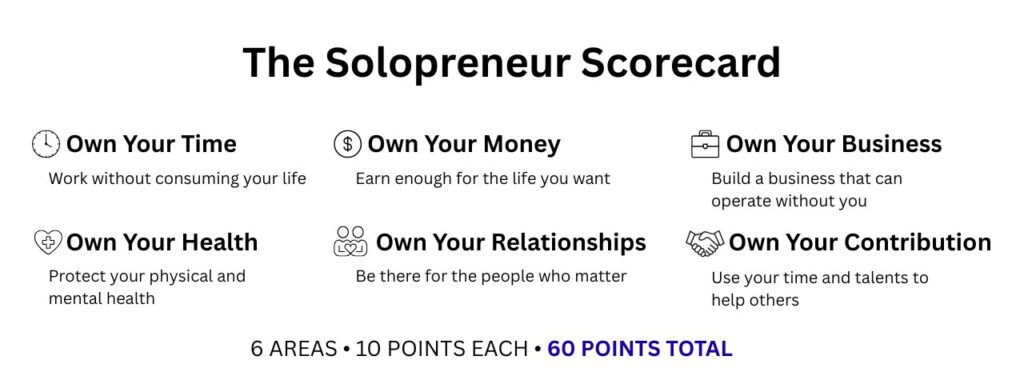
That's why I created the Solopreneur Scorecard.
Instead of measuring success with one number, like revenue, it measures six areas of life:
- Own Your Time
- Own Your Money
- Own Your Business
- Own Your Health
- Own Your Relationships
- Own Your Contribution
Each category receives a score from 1 to 10, for a maximum score of 60.
But getting a perfect 60 isn't really the point.
The scorecard is designed to show you where your life may have become lopsided.
You might be crushing it financially while neglecting your health. You might have plenty of free time but still own a business that falls apart whenever you leave. Or you might have built a wonderful business and family life but realize you're not giving much of your time or resources to others.
The score gives you something concrete to look at and ask:
Where do I want to improve next?
Because I've come to believe something pretty simple:
If revenue is the only number on the scoreboard, eventually we may sacrifice everything else trying to make that number bigger.
It's time to measure what matters.
How the Solopreneur Scorecard Works
The Solopreneur Scorecard isn't meant to be a complicated life-tracking system.
I don't want you spending an hour calculating whether you're a 7.3 or a 7.6.
Instead, review each of the six categories, look at the benchmarks I've provided, think honestly about the last three months and give yourself a score from 1 to 10.
That's it.
My goal with this framework is:
Precise benchmarks. Simple scoring.
Where good research gives us useful numbers, we'll use them. But I'm more interested in helping you reflect honestly on your life than creating a mathematically perfect score.
I recommend completing the scorecard once per quarter.
Your scores will change. That's normal.
Your business might have an incredible quarter financially while requiring more of your time. A family situation might temporarily lower your Relationship score. A difficult business environment might lower your Money score even though you're doing everything right.
The goal isn't to get a perfect 60 every quarter.
It's to notice what's changing and decide where you want to improve next.
I recently completed the scorecard myself and scored 45 out of 60.
I'll show you exactly how I arrived at that score as we go through each category.
1. Own Your Time
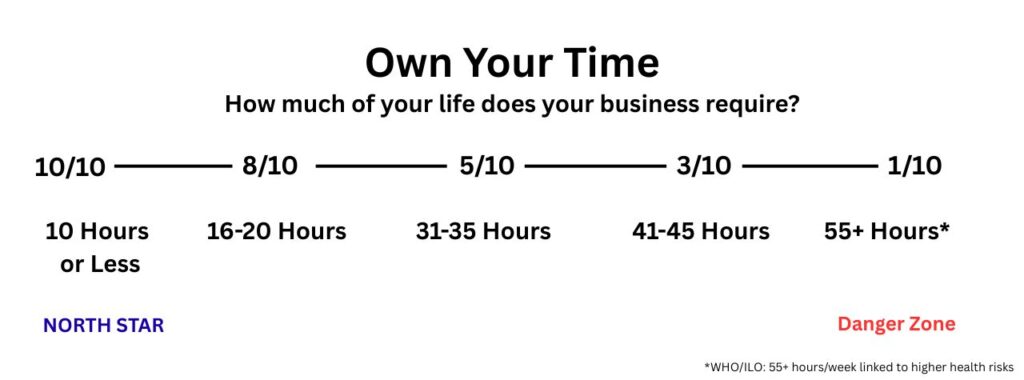
Question: How much of your life does your business require?
For years, working more was treated almost like a badge of honor in entrepreneurship.
I don't want that badge.
One of the primary reasons I became a solopreneur was to have more control over my time.
That doesn't mean I don't enjoy working. I do. Sometimes that's actually the problem.
When you enjoy your business, it's remarkably easy to justify another hour of work. Then another. Then another.
Eventually, you've created the exact situation you were trying to escape.
That's why the first category in the Solopreneur Scorecard measures your average intentional work hours per week.
| Score | Average Intentional Work Hours Per Week |
|---|---|
| 10 | 10 or fewer |
| 9 | 11–15 |
| 8 | 16–20 |
| 7 | 21–25 |
| 6 | 26–30 |
| 5 | 31–35 |
| 4 | 36–40 |
| 3 | 41–45 |
| 2 | 46–54 |
| 1 | 55+ |
I'm intentionally putting a line in the sand here.
A score of 10 means working 10 hours per week or less.
That's not where I am today. It's where I'd eventually like to go.
On the other end, 55 hours or more earns a score of 1.
That's not an arbitrary number. The World Health Organization and International Labour Organization have reported that working 55 hours or more per week is associated with a higher risk of stroke and death from ischemic heart disease compared with working 35 to 40 hours per week.
I don't think building a successful business should require putting our health at risk.
And importantly, I'm not prescribing a three-day workweek.
I happen to like working three days per week. But 20 hours could mean three longer workdays, five four-hour mornings or another schedule that works better for your life.
The number of days isn't what matters.
What matters is how much of your life your business requires.
What Counts as Work?
I count the hours I'm intentionally working on or in my business.
That includes creating content, meetings, strategy, email, administrative work and other tasks necessary to keep the business moving.
But mindlessly scrolling social media doesn't become “work” just because I happen to own a business.
The goal also isn't to race toward 10 hours per week by simply doing less and allowing the business to collapse.
The challenge is much more interesting:
How can you maintain or increase the profit you want while progressively requiring fewer hours of your life?
That might mean delegating, eliminating unnecessary work, spending less time in your inbox, creating better systems or simply deciding that some things don't need to be done at all.
As your business matures, the goal is to become less of an operator and more of an owner.
My Own Your Time Score: 7/10
When I completed my first Solopreneur Scorecard, I estimated that I was working around 20 to 25 intentional hours per week.
I gave myself a 7 out of 10. I'm proud of that, but I also know there's room to improve.
My long-term goal isn't to fill the hours I've reclaimed with even more business.
It's to keep building a business that gives me more freedom to use those hours elsewhere.
Because working less isn't the goal by itself.
Owning more of your time is.
2. Own Your Money
Question: Does your business pay you enough to support the life you want?
Revenue gets a lot of attention in entrepreneurship.
“I built a seven-figure business.”
“I had my first $100,000 year.”
“I made $50,000 this month.”
Those numbers can be exciting, but they don't necessarily tell us much about the life of the business owner.
A business could generate $500,000 in revenue while the owner barely pays themselves. Another business could generate significantly less revenue while providing its owner with a comfortable income, plenty of financial margin and more control over their time.
Which business is more successful?
For the Solopreneur Scorecard, I don't care about revenue nearly as much as I care about Owner Spendable Compensation.
That's the money your business actually provides you to live your life after accounting for taxes and the benefits you need to provide for yourself.
Then we compare that number with something I call your Enough Number.
What's Your Enough Number?
Your Enough Number is the amount of annual spendable income you need to comfortably fund your lifestyle, save and invest for the future, and enjoy some of life's extras.
And everyone's number will be different.
A single 28-year-old living in a lower-cost area may need significantly less than a 45-year-old supporting a family of five.
That's okay.
This isn't a competition to see who can create the biggest Enough Number.
In fact, the entire point is to eventually stop moving the goalpost.
If you constantly increase your lifestyle every time your income increases, enough will always be somewhere in the distance.
There's always a bigger house, a nicer car, a more expensive vacation and another upgrade.
At some point, we need to be able to look around and say:
This is a pretty great life. I have enough.
How to Score Own Your Money
Once you've determined your Enough Number, compare it with the annual spendable compensation your business provides you.
| Score | Percentage of Your Enough Number |
|---|---|
| 10 | 120%+ |
| 9 | 110–119% |
| 8 | 100–109% |
| 7 | 90–99% |
| 6 | 80–89% |
| 5 | 70–79% |
| 4 | 60–69% |
| 3 | 40–59% |
| 2 | 20–39% |
| 1 | Under 20% |
Notice what happens at the top.
The scoreboard stops.
If your Enough Number is $75,000 and your business provides $90,000 of spendable compensation, you get a 10.
If your business eventually provides $180,000, you're still a 10.
You don't get a 15.
That's intentional.
I want this score to reward financial margin, not endless accumulation.
Once your business is providing enough for you to live comfortably, prepare for your future and enjoy your life, increasing your income can certainly be a goal.
It just doesn't make you better at this particular game.
Give Yourself Time to Get There
If you're just starting your business, you might score a 1.
That's okay.
The goal isn't to start at 10.
The goal is to know which direction you're moving.
Maybe your business initially covers 20% of your Enough Number. Eventually it covers 50%. Then 80%. Then one day your business can completely support the life you've intentionally designed.
That's an incredible accomplishment.
Just remember that once you get there, there's another skill to practice:
Contentment.
My Own Your Money Score: 10/10
When I completed my first Solopreneur Scorecard, my business was providing more than 120% of my Enough Number.
That gave me a 10 out of 10.
In previous years and even previous quarters, that wouldn't always have been the case.
And it won't necessarily be the case every quarter going forward.
Business income fluctuates.
That's another reason I like reviewing this score quarterly. A lower score isn't necessarily a crisis. It's information.
It gives me a chance to ask why my income changed and whether I need to make an adjustment.
But when I reach a 10, the scorecard also reminds me of something equally important:
I don't need to keep chasing more simply because more is available.
Enough can actually be enough.
3. Own Your Business
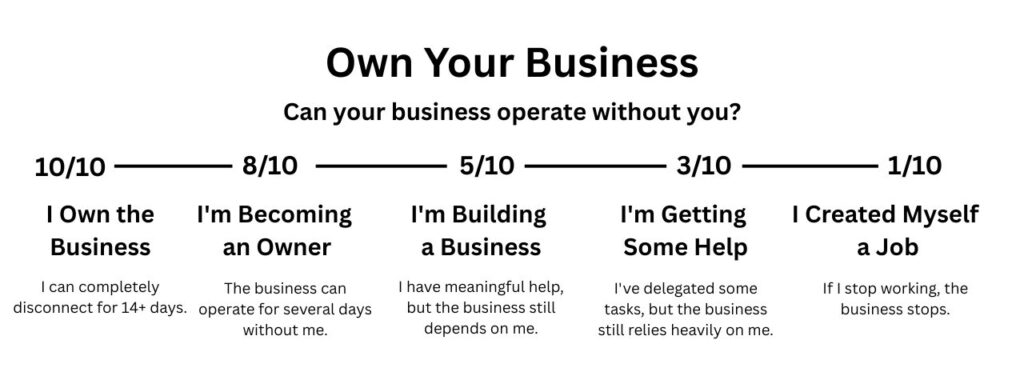
Question: Do you own your business, or does your business own you?
One of the strange things about becoming a solopreneur is that you can leave your job only to accidentally create another one for yourself.
Except now you're the employee, manager, HR department, marketing department, salesperson and CEO.
I've definitely fallen into this trap.
There are plenty of things I still do in my business that someone else could probably do, including responding to emails, managing social media, coordinating with contractors, overseeing content production and making sure everything is properly set up before a YouTube video goes live.
I'm also still the talent in most of my videos.
None of these things are necessarily bad. Some of them may even be necessary when you're starting out. But I don't want to be doing all of them forever.
From Operator to Owner
As my business grows, I want more of my working hours spent on the things I'm uniquely suited to do.
For me, that's developing ideas and philosophies, setting the vision for the business, building important relationships, interviewing interesting people, mentoring my team and occasionally being the talent when I genuinely want to be.
Everything else deserves a couple of questions:
Can someone else do this? And could they eventually do it better than I can?
If the answer is yes, I should at least consider whether that work belongs on my plate permanently.
Delegation isn't just about freeing up time. It's about allowing myself to spend more of my limited working hours doing the things where I can provide the most value.
How to Score Own Your Business
This category is harder to reduce to a perfect mathematical formula.
So instead of pretending there's a precise percentage that determines whether you're an owner or operator, I use these descriptions as benchmarks.
10: I own a business that doesn't own me.
I can completely disconnect for 14 days or more and trust that the business will continue moving forward. Almost all of my work is focused on my unique contribution.
8: I'm becoming an owner.
The business can operate for several days without me. Most recurring operations are handled by other people or systems, and most of my working time goes toward things that only I should do.
5: I'm building a business.
I have meaningful help and can occasionally step away, but the business still depends heavily on me to keep things moving.
3: I'm still the main employee.
I may have some help, but most production, administration and decision-making still runs through me.
1: I've created myself a job.
I do virtually everything. If I stop working, the business stops.
You don't need to spend 20 minutes deciding whether you're technically a 6 or a 7. Look honestly at the descriptions and choose the number that best represents where you are today.
There's Nothing Wrong With Starting at 1
If you launched your business six months ago, there's a pretty good chance you're the one doing everything.
That's normal.
The problem isn't starting there. The problem is staying there forever when that's not the life you want.
As the business becomes more profitable, I want to use some of that financial success to progressively remove myself from work that doesn't require me.
That could mean hiring contractors, automating repetitive processes, creating better systems, eliminating work that isn't producing meaningful results or simply trusting someone else to do something differently than I would.
Over time, I want the progression to look something like this:
I've created myself a job.
↓
I'm building a business.
↓
I'm becoming an owner.
↓
I own a business that doesn't own me.
That's the direction I'm trying to move.
The 14-Day Test
My ultimate benchmark is pretty simple.
Could I take a two-week vacation and completely disconnect?
That means no email, Slack, phone calls or checking YouTube Studio. I don't want to be telling my family, “I'll just take five minutes to make sure everything is okay.”
I want to be able to leave for 14 days and trust the people and systems I've put in place to keep the business moving forward.
That doesn't mean I never want to work again. There are parts of my business I hope I'm still doing decades from now because I genuinely enjoy them.
I'd love to spend my working hours thinking about new ideas and philosophies, creating, coaching, developing relationships and setting the vision for the businesses I own.
The difference is that I want to choose that work instead of being required to do it.
My Own Your Business Score: 6/10
When I took the Solopreneur Scorecard for the first time, I gave myself a 6 out of 10 in this category.
I'm proud of the business I've built, but I'm still somewhere between owner and operator.
I have people helping me, and I've delegated meaningful parts of the business. But I'm also still too involved in some of the day-to-day work.
That's one of the clearest opportunities the scorecard revealed for me.
My next level isn't necessarily another revenue goal. It's becoming less necessary to the daily operation of the business.
If I can continue building a profitable business while delegating more operational work, my Own Your Business score should improve and my Own Your Time score may improve along with it.
Then I get to decide what to do with those reclaimed hours. Maybe they go toward my health, relationships or contribution. Maybe I use some of them to develop new ideas. Or maybe I simply enjoy having more time to live my life.
That's the kind of business growth I'm interested in.
I don't just want the business to get bigger. I want my life to get better along with it.
4. Own Your Health
Question: Are you taking care of yourself well enough to show up for the rest of your life?
When I think about the different areas of this scorecard, health has to come before relationships and contribution.
If I neglect my health, I'm also neglecting my ability to successfully complete my day.
And successfully completing my day means a lot more to me than finishing everything on my to-do list.
I want enough physical and mental energy to show up as a good husband, father, business owner, friend, son and community member. When I'm not taking care of myself, eventually all of those areas suffer.
That's why I don't think someone earning $500,000 per year while working 20 hours per week is necessarily winning if they're also sleeping five hours per night, eating poorly and never exercising.
They might be winning on paper, but how sustainable is that life?
Eventually, our health catches up with us.
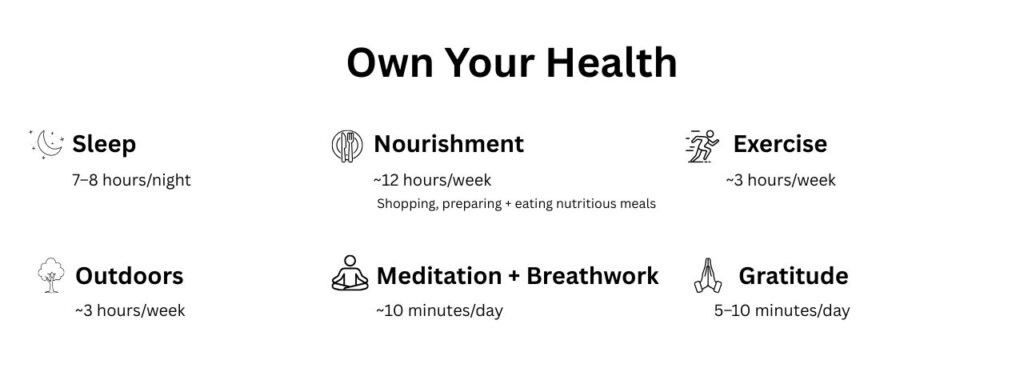
The Six Health Investments I Prioritize
Health is difficult to reduce to a single number, so instead of trying to perfectly calculate every healthy behavior, I look at six areas where I want to consistently invest my time.
Sleep: 7 to 8 hours per night
I aim for around eight hours of sleep each night, or roughly 56 hours per week.
Sleep isn't wasted time that gets in the way of productivity. It's part of what allows me to be productive, healthy and present during the hours I'm awake.
Nourishment: Around 12 hours per week
This includes more than the time I spend eating.
I'm talking about grocery shopping, thinking intentionally about what I'm buying, preparing healthier meals and sitting down to enjoy them.
When we're busy, convenience can easily become the default. Taking time to nourish ourselves means being more intentional about what we're putting into our bodies.
Exercise: Around 3 hours per week
The U.S. Department of Health and Human Services recommends that adults get at least 150 minutes of moderate-intensity aerobic physical activity each week, along with muscle-strengthening activity.
I've rounded my own target to about three hours per week.
You don't need to become an extreme athlete. You need to consistently move your body.
Outdoor time: Around 3 hours per week
Research has also connected spending time in nature with physical and mental health benefits.
I like three hours per week because it's meaningful without being unrealistic. This could be taking a walk, playing outside with your kids, hiking, gardening or even cutting the lawn.
The point is to get outside.
Meditation and breathwork: Around 1 hour per week
Ten minutes per day gets you pretty close.
For me, this might mean using the Calm app, practicing breathwork or meditating. The goal is to intentionally create moments where my mind isn't constantly reacting to the next notification, task or problem.
Gratitude: Around 1 hour per week
I also want gratitude to be a regular practice, not something I remember to do occasionally.
Taking five or ten minutes to write down three things I'm grateful for helps me recognize what's already good in my life instead of constantly thinking about what I need to accomplish next.
Taken together, these are the health investments I want to protect.
How to Score Own Your Health
I originally considered creating a mathematical formula for this section.
For example, I could track exactly how many hours I slept, exercised, spent outside, meditated and prepared healthy food every week. Then I could calculate a percentage and convert it into a score.
But I don't think most people would do that.
I probably wouldn't want to do it every quarter either.
So instead, I use the numbers above as benchmarks and then honestly assess how consistently these habits have been part of my life over the past three months.
10: My health is foundational.
These healthy habits are consistently built into my life. I'm protecting my sleep, nourishment, exercise, outdoor time, mental stillness and gratitude.
8: My health is a priority.
Most of these habits are consistent. There may be a few areas where I could improve, but work rarely comes at the expense of taking care of myself.
5: My health is inconsistent.
I have some healthy routines, but several of them disappear when work or life gets busy.
3: My health gets what's left over.
Work and other responsibilities regularly crowd out sleep, exercise, nourishment or other healthy habits.
1: My lifestyle is unsustainable.
I'm consistently sacrificing my physical or mental health to maintain the way I'm currently living and working.
Don't spend 20 minutes trying to determine whether you're technically a 7 or an 8.
Look at the benchmarks, think about your last quarter and be honest with yourself.
Precise benchmarks. Simple scoring.
That's the goal.
My Own Your Health Score: 9/10
When I completed my first Solopreneur Scorecard, I gave myself a 9 out of 10 for health.
I'm probably the healthiest I've ever been in my adult life, and that feels great.
I'm sleeping well, exercising consistently and being much more intentional about what I eat. I'm spending time outdoors, meditating and making gratitude part of my routine.
I didn't give myself a 10 because there are still things I'd like to improve, and that's okay.
The purpose of this score isn't to declare that I've perfected my health.
It's to recognize that what I'm doing is working and encourage myself to continue protecting it.
There will always be another business opportunity, another email to answer and another task I could complete.
My health gives me the ability to do all of those things, but more importantly, it gives me the ability to enjoy the rest of my life.
Taking care of myself helps me show up for everyone and everything that matters to me.
5. Own Your Relationships
Question: Are you making enough time for the people who matter most?
One of the biggest reasons I wanted more control over my work was so I could have more control over my relationships.
I didn't want to be the dad who was constantly traveling while my kids were growing up. I didn't want my wife to get whatever energy I had left after work. I didn't want to become so consumed by my business that friendships, family and community slowly disappeared from my life.
After all, what would be the point of building a successful business if I didn't have strong relationships with people I cared about?
There's some compelling research behind this idea too.
I interviewed Dr. Robert Waldinger, director of the Harvard Study of Adult Development, which has followed people's lives for more than 80 years. One of the study's biggest lessons is that strong relationships are closely connected with happier and healthier lives.
That makes relationships more than something we should squeeze in after we're done working.
They deserve space on the calendar.
Make Time for Relationships
I like measuring things, so my instinct is to put an exact number of hours around relationships.
There is some value in doing that.
For example, in my own life, I want to intentionally create time to connect with my wife throughout the week. That might include a few hours of morning connection and another couple of hours for a date night or date day.
But relationships are much broader than marriage.
For you, the important people might include a spouse or partner, children, parents, siblings, close friends, neighbors or other people in your community.
You might be single. You might not have children. Your kids might be grown and living across the country.
The specific relationships will be different, but the principle is the same:
People need your time.
That's why I think “relationship hours” are useful as a concept without requiring everyone to track them precisely.
You don't need to start a stopwatch when you call your mom or log 90 minutes in a spreadsheet after having dinner with a friend.
Instead, look at your calendar and your life.
Are you intentionally creating time for the people you say matter most?
Presence Matters Too
Hours aren't everything.
I can technically spend an entire evening with my family while staring at my phone and thinking about work.
That's not the kind of relationship time I'm trying to create.
I want to be there when it matters, and when I'm there, I want to actually be present.
That could mean eating dinner together, taking a family vacation, going on a date with your partner, calling your parents, meeting a friend for coffee, creating family traditions or simply having enough margin in your day to talk when someone you love needs you.
These moments may not generate revenue or improve your business metrics, but they are a big part of why I want control over my time in the first place.
How to Score Own Your Relationships
For this category, think about the relationships that matter most to you and how well you've protected them over the past three months.
10: I'm there when it matters.
I consistently protect meaningful time for the people closest to me. I'm present during that time, and my business rarely causes me to miss the moments and relationships I value most.
8: My relationships are a priority.
I regularly make time for meaningful connection and shared experiences, although busy seasons occasionally interfere.
5: My relationships get inconsistent attention.
I care deeply about the people in my life, but work and other obligations too often determine when they get my time and attention.
3: My relationships get what's left over.
I regularly miss opportunities for connection because work or other priorities come first.
1: My business is costing me relationships.
The people closest to me regularly experience my absence, distraction or unavailability because of my work.
There's one additional question that can make this score a lot more honest:
Would the people closest to you give you roughly the same score?
You don't necessarily need to ask them, although you certainly could.
Just considering the question might change the number you give yourself.
My Own Your Relationships Score: 9/10
When I completed my first Solopreneur Scorecard, I gave myself a 9 out of 10 for relationships.
My relationships are a major priority in my life, and I believe the people closest to me know that.
I'm there for my wife and kids when it matters. I intentionally make time for my family, and having the flexibility to do that is one of the things I value most about being a solopreneur.
That doesn't mean I'm a perfect husband, father, son or friend. There will always be ways I can improve.
But I feel good about where my priorities are.
When I think about what I ultimately hope my kids say about me someday, I don't expect them to remember my annual business revenue or how many YouTube subscribers I had.
I hope they remember that I was there for them when it mattered.
I hope they saw someone who knew what he wanted out of life and intentionally went after it while still making room for his family, health, purpose and gratitude.
Most importantly, I hope my example helps them develop the confidence to create lives that are right for them.
That's a much more meaningful measure of success to me than anything I could find on a business dashboard.
A successful business should create more room for the people you love, not less.
6. Own Your Contribution
Question: What are you doing with what you have to help others?
Once we're taking care of ourselves and making time for the people closest to us, I think there's another important question to ask.
How are we helping people beyond our immediate circle?
For a long time, I thought about giving back primarily in terms of volunteering or donating money.
I still think both of those things are important, but I've started thinking about contribution much more broadly.
We all have something we can give.
It might be our time, knowledge, skills, network, voice, energy, attention, availability, money or other resources.
The important part is using some of what we have to help someone else without expecting something in return.
Contribution Doesn't Have to Be Complicated
You don't need to start a nonprofit or spend every Saturday volunteering to contribute.
Maybe you mentor a younger person in your profession.
You could introduce two people in your network who would benefit from knowing each other, coach your kid's soccer team, volunteer at a school, help a neighbor, use your professional skills for free or support an organization doing work you believe in.
Contribution can be even simpler than that.
Maybe you take 30 minutes on a Friday afternoon to write thoughtful Google reviews for five small businesses you love in your community.
That might not feel like traditional volunteering, but think about what you're doing. You're using your time and your voice to support another business owner without asking them for anything in return.
That's contribution.
How to Score Own Your Contribution
I do want a measurable benchmark here because good intentions are easy.
Actually making time to help is harder.
My goal is to dedicate roughly 50 hours per year to contribution. That's approximately one hour per week with some flexibility built in for vacations, busy seasons and the natural rhythm of life.
Here's the scoring scale:
| Score | Contribution Hours Per Year |
|---|---|
| 10 | 50+ hours |
| 9 | 45–49 |
| 8 | 40–44 |
| 7 | 35–39 |
| 6 | 30–34 |
| 5 | 25–29 |
| 4 | 20–24 |
| 3 | 15–19 |
| 2 | 5–14 |
| 1 | Under 5 |
You don't need to meticulously track every minute.
At your quarterly check-in, estimate your current pace. If you've been contributing around three hours per month, you're on pace for roughly 36 hours for the year and would give yourself around a 7.
The purpose is awareness, not perfect accounting.
Why I Measure Time Instead of Impact
I'd love for the things I do to create a measurable positive impact.
In fact, one of my long-term goals is to spend more time helping young people develop financial literacy and confidence with money. I'd love to create a nonprofit focused on financial education and empowerment where we could measure whether we're actually helping young people improve their financial lives.
But I don't think impact belongs in the personal score.
We can't always know how much our contribution matters to someone else.
You might mentor someone for an hour and never realize that one conversation changed the direction of their career.
A teacher may influence a student's life and not hear about it until 20 years later.
A positive review might help a local business attract a new customer, and you'll never know it happened.
I can control whether I give.
I can't always control or measure what happens afterward.
That's why time is the score and impact is the aspiration.
My Own Your Contribution Score: 4/10
When I completed my first Solopreneur Scorecard, this was my lowest category.
I gave myself a 4 out of 10.
I do give back and contribute, but when I honestly looked at the amount of time I was dedicating to it, I wasn't anywhere close to my goal of 50 hours per year.
That's something I want to change.
And this is exactly why I wanted to create this scorecard in the first place.
Without measuring Contribution, I could look at my business income, my work schedule, my health and my family life and conclude that everything was going incredibly well.
And a lot of it is.
But the scorecard exposed something that deserves more of my attention.
I want to spend more of my time helping young people understand financial literacy, investing, saving and the opportunities that can come from taking control of their money early in life.
Someday, I hope that becomes a much larger part of what I do.
For now, I can start by making more room for it.
Contribution doesn't require waiting until you're wealthy enough, successful enough or retired enough to give back.
You already have something somebody else could use.
The question is whether you're willing to share some of it without asking for anything in return.
Use what you have to make someone else's life a little better.
My First Solopreneur Score: 45/60
After developing these six categories, I decided I needed to be the first person to take the test.
Here's where I landed:
| Category | My Score |
|---|---|
| Own Your Time | 7/10 |
| Own Your Money | 10/10 |
| Own Your Business | 6/10 |
| Own Your Health | 9/10 |
| Own Your Relationships | 9/10 |
| Own Your Contribution | 4/10 |
| Total | 45/60 |
At first glance, 45 out of 60 sounds pretty good.
But the total isn't actually what interests me most.
The individual scores tell me much more.
I'm doing really well with my health, relationships and money. I don't need to spend the next quarter figuring out how to turn my Money score from a 10 into a 12. There is no 12.
Instead, I can look at my 6 in Business and my 4 in Contribution and see two areas where I have room to grow.
Look for the Leverage
My Business score may be the most interesting opportunity.
I'm currently a 6 because I'm still too involved in some of the operational parts of my business. If I delegate more of that work and become less necessary to the daily operation, I could potentially move my Business score from a 6 to an 8.
That could also reduce the number of hours I work, which would improve my Time score.
Then I could use some of those reclaimed hours to give back, potentially improving my Contribution score too.
One change could improve three areas of my life.
That's the kind of insight I'm hoping this scorecard creates.
Instead of looking at your lowest score and automatically deciding that it deserves all your attention, ask yourself:
Which improvement could have the greatest positive effect on the rest of my life?
Sometimes the answer might surprise you.
Your Score Will Change With the Seasons
I'm writing this at the beginning of a new quarter, and I already have a pretty good idea that my next score will be lower than 45.
I'm working more hours in the business right now, and I'm earning less than I did during the quarter I scored above.
That will probably lower both my Time and Money scores.
Does that mean my life is suddenly worse?
I don't think so.
Businesses have seasons, and so do our lives.
You might be launching a new product and working more hours for a few months. You might have a new baby and temporarily spend less time on your business. You could be caring for an aging parent, dealing with a difficult economy or helping your spouse or partner through an especially demanding season.
The scorecard should reflect those realities.
If your Relationships score falls from an 8 to a 6, don't change the definition of an 8 so you can feel better about yourself.
Give yourself the 6.
Then ask why.
Maybe the answer is something you want to change next quarter. Maybe it's simply the season you're in and you're making the best choice available to you right now.
Either way, the score gave you a reason to stop and think about it.
Give Yourself Some Grace, But Stay Honest
I want this framework to have standards.
That's why 55 or more working hours earns a 1 in Time. It's why 50 contribution hours per year earns a 10. It's why we established specific health benchmarks instead of simply saying, “Try to be healthy.”
If everything is relative, the scorecard doesn't tell us very much.
At the same time, life doesn't happen inside a spreadsheet.
There will be quarters when your business struggles, your health takes priority, your family needs more of you or an incredible opportunity temporarily requires additional work.
Give yourself some grace during those seasons.
Just don't use grace as an excuse to ignore a pattern that has lasted for years.
There's a big difference between saying, “I'm working 50 hours per week because I'm launching something this quarter” and realizing you've been saying some version of that for the past five years.
That's one reason I like checking in quarterly.
Three months is long enough to reveal a pattern, but short enough to make a change.
Don't Chase 60
I don't think the goal of the Solopreneur Scorecard should be getting a perfect 60 and keeping it there forever.
I'm not even sure that's realistic.
There will always be tradeoffs.
The goal is to avoid becoming so successful in one area that you unintentionally sacrifice everything else.
You might decide to accept a lower Business score for a season because you're creating something you deeply care about.
You might temporarily earn less because you've intentionally reduced your workload.
You might spend fewer hours contributing because someone in your family needs more of your attention.
The score doesn't make those decisions for you.
It helps you see them.
For me, that's the real value of measuring these six areas together.
I don't want to maximize one part of my life. I want to build a life that works as a whole.
How to Take the Solopreneur Scorecard Yourself
Now it's your turn.
Set aside a few minutes and think about the last three months of your life and business.
Give yourself a score from 1 to 10 in each of the six categories:
| Category | Your Score |
|---|---|
| Own Your Time | ___ / 10 |
| Own Your Money | ___ / 10 |
| Own Your Business | ___ / 10 |
| Own Your Health | ___ / 10 |
| Own Your Relationships | ___ / 10 |
| Own Your Contribution | ___ / 10 |
| Total | ___ / 60 |
Use the benchmarks throughout this article to guide you, but don't overthink it.
If you're debating whether you're a 6 or a 7, choose the number that feels most honest and move on.
The entire exercise should only take a few minutes.
Once you've finished, don't immediately focus on the total. Look across your six individual scores and ask yourself a few questions:
- Where am I doing really well?
- Where have I become lopsided?
- Which area needs more attention?
- Could improving one category naturally improve another?
Then choose one area to focus on during the next quarter.
You don't need six new goals.
If you're working 50 hours per week, perhaps your next goal is to eliminate or delegate enough work to get below 45.
If your Business score is low, identify one recurring responsibility that someone else could take over.
If your Health score concerns you, start by protecting one of the health habits you've been neglecting.
If your Relationships score is lower than you'd like, put recurring time with someone you care about on the calendar.
If Contribution is your opportunity, find a way to start giving an hour of your time, knowledge, network, voice or resources each week without expecting something in return.
Then come back in three months and take the scorecard again.
Don't worry about whether the number always goes up.
Pay attention to why it changed.
Your Business Is Only One Part of Your Life
I love being a business owner.
I love creating things, developing ideas, interviewing interesting people and seeing something I've built make money.
I hope I'm still doing some version of this work decades from now.
But I don't want “business owner” to become my entire identity.
I want to be a husband, father, friend, son, coach, student and community member. I want to stay curious, develop new interests and continue becoming a more interesting person as I get older.
Our businesses should be one part of who we are, not the entire story.
That's ultimately what the Solopreneur Scorecard is trying to protect.
We're budgeting more than money.
We're budgeting our time, energy, attention, health, relationships and resources so that the business we're building actually supports the life we want to live.
Some quarters will be better than others.
Some categories will rise while others fall.
That's life.
Keep checking in. Stay honest about what's working and what isn't. Make adjustments when you need to.
Research tells us what's possible.
Extremes show us what to avoid.
Wisdom is finding the middle way.
Build a profitable business. Take care of yourself. Make time for people you love. Give something back. And leave enough room in your life to become more than the work you do.
Measure what matters, and build a business that improves your life instead of consuming it.