
Pay Off Your Mortgage or Invest? A Simple Framework for Deciding
There is a long-running personal finance debate: Should you pay off your mortgage early or invest the extra money instead?
Both can help you build wealth. Investing gives your money more time to compound, while paying off your mortgage lowers your monthly expenses and can create more financial freedom.
If I were making this decision today, I wouldn’t treat it as an either-or choice. I’d focus on the order.
For most families, I’d prioritize building a strong financial foundation and investing enough to reach Coast FIRE before aggressively paying off the mortgage.
That’s actually the opposite order my family followed.
We paid off our mortgage first and reached Coast FIRE afterward. I don’t regret becoming mortgage-free at all, but knowing what I know today, I’d approach the journey a little differently.
Let’s start with the financial foundation I’d want in place before choosing either path.
Before You Pay Off Your Mortgage or Invest, Build Your Financial Foundation
Before deciding whether extra money should go toward your mortgage or investments, I’d make sure the rest of your financial foundation is solid.
For us, paying off the mortgage wasn’t step one. We had already eliminated our consumer debt, built up an emergency fund and were consistently investing for retirement.
Here are a few areas I’d prioritize first:
- Pay off high-interest consumer debt. Credit cards and other high-interest debt should generally take priority over making extra mortgage payments or investing beyond your employer match.
- Build an emergency fund. Having cash available for unexpected expenses can help prevent you from going back into debt when life happens.
- Get your employer retirement match. If your employer offers a 401(k) match, I wouldn’t pass up that benefit to make extra mortgage payments.
- Protect your family. Make sure you have appropriate insurance coverage and basic estate planning documents in place.
- Start investing consistently. You don’t necessarily need to max out every retirement account before paying extra on the mortgage, but I’d want investing to already be part of the plan.
Once those pieces are in place, the mortgage payoff versus investing question becomes much more interesting. You’re no longer deciding between financial security and wealth building. You’re deciding how you want to use your extra money to build wealth and create more freedom.
The Case for Investing Instead of Paying Off Your Mortgage
If you look at this decision strictly through a wealth-building lens, investing often has the advantage, especially if you have a relatively low mortgage interest rate and a long investing timeline.
The basic argument is simple: paying extra on a 4% mortgage gives you a guaranteed return roughly equal to the interest you're avoiding. Investing that money could produce a higher return over the long term, but unlike paying down your mortgage, those returns aren't guaranteed.
Investing Gives Your Money More Time to Compound
One of the strongest arguments for investing is compound growth.
Historically, the U.S. stock market has produced higher average returns over long periods than the interest rates many homeowners have on their mortgages. Of course, past performance doesn't guarantee future results.
So instead of assuming you'll earn historical stock market returns, let's use a more conservative 7% average annual return for this example.
Let's say you have an extra $1,000 per month and you're deciding whether to invest it or put it toward your mortgage.
If you invested that $1,000 each month for 20 years and earned an average 7% annual return, with returns compounded monthly, you'd end up with approximately $521,000.
You would have contributed just $240,000 yourself. The remaining $281,000 would come from investment growth.
That's the power of giving your money time to compound.
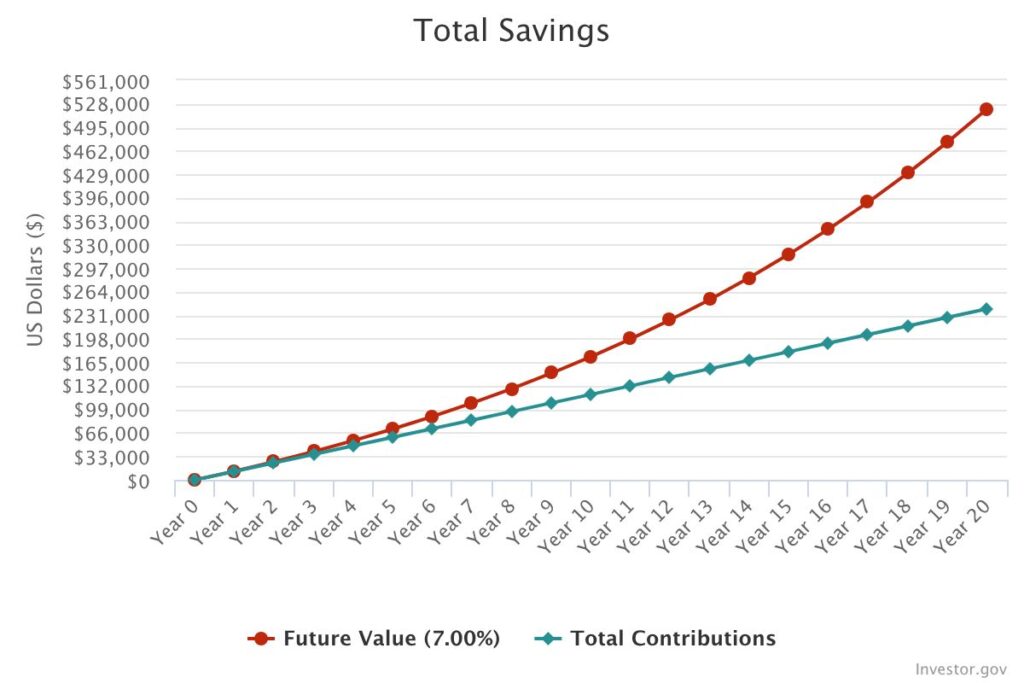
You can run your own numbers using the Investor.gov Compound Interest Calculator and adjust the monthly contribution, time horizon and expected return.
This same idea is also at the heart of Coast FIRE. By investing enough earlier in life, you may reach a point where your existing investments have enough time to potentially grow into what you'll need for retirement, even if you significantly reduce or stop future contributions.
A Low Mortgage Rate Can Be Valuable
Your mortgage interest rate matters a lot in this decision.
If you have a 3% or 4% fixed-rate mortgage, putting extra money toward it gives you a predictable return through the interest you avoid.
But if you have decades to invest and believe your investments can earn more than your mortgage rate over that period, investing the extra money may result in greater long-term wealth.
The tradeoff is certainty.
Paying down a 4% mortgage gives you a guaranteed benefit. A 7% investment return is an assumption, not a guarantee. The stock market could perform significantly better or worse, particularly over shorter periods.
As your mortgage rate gets higher, the decision becomes more competitive. Paying down a 7% mortgage, for example, gives you a guaranteed return that's much harder for an investor to ignore.
That's why I don't think there's one universal answer to the mortgage payoff versus investing debate.
The numbers matter. And so do your goals.
The Case for Paying Off Your Mortgage Early
The math may favor investing in certain situations, but personal finance isn't only about maximizing your net worth.
Paying off your mortgage provides something investing can't guarantee: certainty.
Once the mortgage is gone, your required monthly expenses drop. You own your home outright, and the money that previously went toward principal and interest can be redirected toward investing, travel, reducing work hours or other financial goals.
That's a powerful feeling.
A Guaranteed Return on Your Money
When you make an extra mortgage payment, you're essentially earning a guaranteed return equal to the interest you would have otherwise paid.
If your mortgage rate is 4%, paying additional principal saves you that 4% interest without exposing the money to stock market volatility.
At 7%, that guaranteed return becomes even more compelling.
This is one reason today's mortgage rate matters so much when deciding whether to invest or pay off your mortgage early. The higher your mortgage rate, the stronger the mathematical case for eliminating the debt.
Lower Monthly Expenses Can Create More Freedom
For me, this was one of the biggest benefits of becoming mortgage-free.
Nicole and I paid off our mortgage when we were 35. Eliminating that monthly payment didn't just improve our balance sheet. It lowered the amount of money our family needed each month.
That eventually gave us more flexibility to make decisions that weren't entirely based on maximizing our income.
When your required monthly expenses are lower, you may have more freedom to change careers, start a business, work fewer hours or simply build a larger margin of safety into your family's finances.
For us, mortgage freedom ultimately became part of a much larger goal: time freedom.
There's an Emotional Benefit Too
This part is difficult to capture in a spreadsheet.
Some people simply sleep better knowing they don't owe anyone money on their home.
There's value in that.
You may theoretically build more wealth by keeping a low-interest mortgage and investing aggressively. But if eliminating your mortgage gives you greater peace of mind, reduces financial stress and helps you feel more secure about your family's future, that's a legitimate part of the decision too.
The goal isn't necessarily to make the choice that produces the largest possible number 30 years from now.
It's to use your money to help create the life you actually want.
Before You Pay Off Your Mortgage or Invest More
Before you start sending thousands of extra dollars toward your mortgage, make sure the rest of your financial foundation is in good shape.
Becoming mortgage-free can be an incredible goal, but I wouldn't prioritize it at the expense of more urgent financial needs.
Build an Emergency Fund First
Extra mortgage payments are difficult to get back.
Once you send $10,000 to your mortgage company, that money becomes home equity. You can't easily use it to replace a broken furnace, cover an unexpected medical bill or get through a job loss.
That's why I would build a solid emergency fund before aggressively paying down your mortgage.
Keeping cash available may not feel as exciting as watching your mortgage balance fall, but liquidity matters.
Pay Off High-Interest Debt
If you're carrying credit card debt at 20% or more, paying extra on a 4% mortgage probably shouldn't be your first priority.
Eliminating high-interest consumer debt gives you a much larger guaranteed financial benefit and frees up cash flow that can eventually be directed toward your mortgage or investments.
I'd generally want credit cards and other high-interest debt out of the way before making aggressive extra mortgage payments.
Don't Give Up Your Employer Match
If your employer offers a 401(k) match, I'd also strongly consider contributing enough to receive the full match before accelerating your mortgage payoff.
An employer match is part of your compensation. Passing it up to make additional mortgage payments could mean leaving valuable retirement money on the table.
After you've established an emergency fund, eliminated high-interest debt and captured your employer match, the mortgage-versus-investing decision becomes much more interesting.
Now you're comparing two potentially good uses of your money instead of choosing between your mortgage and a higher financial priority.
How to Decide: Pay Off Your Mortgage or Invest?
Once your financial foundation is in place, this is where the real decision begins.
I don't think you need a complicated spreadsheet to figure it out. I'd look at five factors.
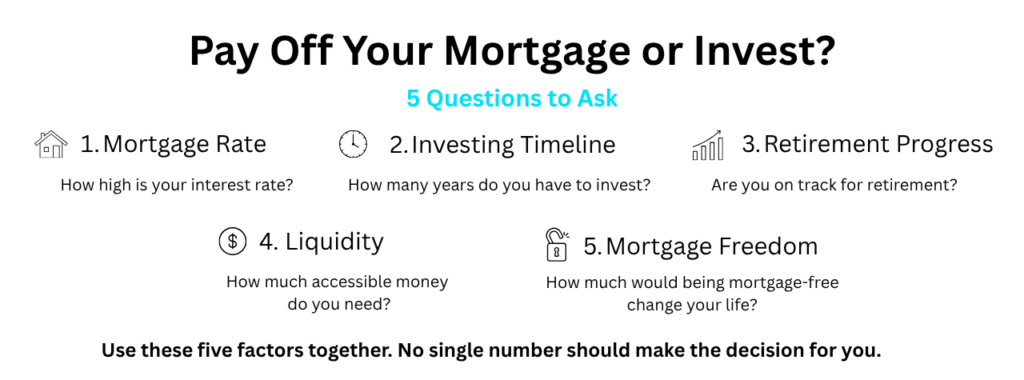
1. What's Your Mortgage Interest Rate?
Start with the easiest number to compare.
Paying extra toward your mortgage provides a guaranteed benefit roughly equal to your mortgage interest rate. Investing offers a potentially higher return, but that return isn't guaranteed.
Generally, the lower your mortgage rate, the more attractive investing becomes. As your mortgage rate increases, paying it off becomes more compelling.
For example, choosing between investing and paying down a 3% mortgage is a very different decision than choosing between investing and paying down a 7% mortgage.
2. How Much Time Do You Have to Invest?
Time favors investing.
If you're 35 and won't need the money for another 25 or 30 years, you have a long runway to ride out market downturns and benefit from compound growth.
If you're five years away from retirement, that calculation looks different.
The shorter your investing timeline, the less comfortable you may be relying on an uncertain stock market return to outperform the guaranteed savings from paying down your mortgage.
3. Are You on Track for Retirement?
Before putting large amounts of extra money into your house, look at how much you've already accumulated for retirement.
If you're significantly behind on retirement savings, I'd be hesitant to prioritize an aggressive mortgage payoff while neglecting your investments.
But someone who is already on track for retirement may have much more flexibility.
This is where concepts like Coast FIRE can be helpful. If you've already accumulated enough that your investments have decades to potentially grow toward your retirement goal, you may feel more comfortable directing additional cash toward becoming mortgage-free.
4. How Important Is Liquidity to You?
This is one of the biggest differences between investing and paying down your mortgage.
Money in a taxable brokerage account is relatively accessible. Money used to pay down your mortgage becomes home equity.
That doesn't make home equity bad. It simply makes it less liquid.
If you're expecting a career change, starting a business, planning a major purchase or simply value having accessible assets, investing may provide greater flexibility.
If you already have plenty of liquid savings and investments, putting more money into your home may be less of a concern.
5. How Much Would Being Mortgage-Free Mean to You?
Finally, ask yourself something that has nothing to do with investment returns:
How would your life change if you didn't have a mortgage payment?
Would you invest more?
Work less?
Take a lower-paying job you enjoy?
Travel more with your family?
Feel more secure?
Or would very little actually change?
That answer matters.
For some people, a low-interest mortgage is simply another monthly bill and doesn't bother them at all. For others, owning their home outright represents an enormous amount of financial security and freedom.
Neither person is necessarily making the wrong decision.
The goal is to understand what you're optimizing for.
What About Doing Both?
You don't necessarily have to choose between paying off your mortgage and investing.
For a lot of families, doing both may be the best answer.
Instead of putting every extra dollar toward your mortgage or every extra dollar into the stock market, you can split the difference.
For example, if you have an extra $1,000 per month, you could:
- Invest $500
- Put an additional $500 toward your mortgage principal
You won't pay off your mortgage as quickly as someone who puts the entire $1,000 toward it. And you probably won't build as large an investment portfolio as someone who invests the entire amount.
But you'll make progress toward both goals at the same time.
This Is the Approach We Took
Nicole and I didn't stop investing while we were paying off our mortgage.
We continued contributing to our retirement accounts while also making extra mortgage payments. As our income increased, we were able to put more money toward eliminating the mortgage without completely sacrificing our long-term investing goals.
For us, that balance worked.
We wanted the security and freedom of owning our home outright, but we also understood how valuable it was to keep investing for retirement.
You don't have to optimize every dollar perfectly.
Sometimes the best financial plan is the one that allows you to make meaningful progress toward multiple goals while still feeling good about the direction your family is headed.
You Can Change the Split Over Time
Your strategy doesn't have to stay the same forever either.
Maybe you start by investing 75% of your extra money and putting 25% toward the mortgage.
As your retirement portfolio grows or your mortgage balance gets smaller, you might shift to 50/50.
Eventually, you may decide you're close enough to mortgage freedom that you want to throw nearly everything at the remaining balance.
Your mortgage payoff and investing strategy can evolve as your financial life changes.
When Paying Off the Mortgage Became the Right Choice for Us
For our family, this wasn't purely a mathematical decision.
Nicole and I continued investing while we paid down our mortgage, but eventually becoming mortgage-free became the goal we wanted to prioritize.
We paid off our mortgage when we were 35 years old.

At the time, we knew there was a good chance we could have earned a higher long-term return by investing more of that money instead. But we weren't only trying to maximize our investment portfolio.
We wanted to lower our family's monthly expenses and create more flexibility in our lives.
Looking back, that's exactly what happened.
Becoming mortgage-free gave us more room to increase our investments, save for our kids' future and eventually make career decisions with less pressure to maximize our income.
Most importantly, it helped us realize that financial independence wasn't only about accumulating more money. It was about needing less money to live the life we wanted.
Would I Make the Same Decision Today?
Yes.
Knowing what I know now, I'd still choose to pay off our mortgage early.
That doesn't mean I think everyone should do what we did.
Our decision worked because we were also investing, had our other financial priorities in order and genuinely valued the freedom that came with eliminating our largest monthly expense.
Someone with a 3% mortgage who loves their career, has a long investing horizon and wants to maximize their potential net worth may reasonably choose to invest instead.
Someone approaching retirement with a 7% mortgage and plenty already invested may reach a completely different conclusion.
The right answer depends on the numbers and what you want your money to do for your life.
Pay Off Your Mortgage or Invest? A Few Examples
Sometimes it's easier to see how this framework works by applying it to a few different situations.
Example 1: A 3% Mortgage With Decades to Invest
Let's say you're 35 years old with a 3% fixed-rate mortgage, a healthy emergency fund, no high-interest debt and you're consistently investing for retirement.
You also have an extra $1,000 per month.
In this situation, I'd lean toward investing more of that money.
Paying down the mortgage would provide a guaranteed 3% benefit, but with several decades ahead of you, investing gives your money a long time to potentially earn a higher return.
If being mortgage-free is still important to you, you could always use a hybrid approach and send a smaller portion toward the mortgage.
Example 2: A 7% Mortgage
Now let's keep everything else the same but change the mortgage rate to 7%.
That's a much more difficult hurdle for investing to beat.
Paying additional principal gives you a guaranteed benefit from avoiding 7% mortgage interest, while earning 7% or more in the stock market is never guaranteed.
In this situation, I'd be much more interested in accelerating the mortgage payoff, assuming you're still maintaining an appropriate level of retirement investing.
Example 3: Five Years From Retirement
Let's say you're 60, planning to retire at 65 and still have a mortgage.
You've accumulated enough investments to support your retirement, but paying off the remaining mortgage would significantly reduce the amount your household needs each month.
In this situation, entering retirement mortgage-free could be very attractive.
Reducing your required expenses may allow you to withdraw less from your investments each year and give you more flexibility when the stock market isn't cooperating.
That doesn't automatically mean you should liquidate a large retirement account to pay off your mortgage. Taxes, account type and your overall retirement plan would need to be considered.
But eliminating the mortgage before retirement could become a much higher priority than it was when you were 35.
Example 4: You Really Want to Be Mortgage-Free
Finally, imagine the math slightly favors investing, but you hate having a mortgage.
You've got your emergency fund. You're investing consistently. You're on track for retirement. And becoming mortgage-free would give you tremendous peace of mind and family flexibility.
Pay off the mortgage.
Personal finance doesn't require you to squeeze the highest theoretical return out of every dollar.
If you've taken care of your other priorities and understand the tradeoff you're making, choosing financial freedom over financial optimization can be a perfectly reasonable decision.
So, Should You Pay Off Your Mortgage or Invest?
If you're looking for one answer that works for everyone, there isn't one.
But here's how I'd think about it:
I'd lean toward investing if you have a low mortgage rate, a long investing timeline, you're still building toward your retirement goals and you value having more liquid assets.
I'd lean toward paying off the mortgage if you have a higher interest rate, you're already in a strong position for retirement, you're approaching retirement or becoming mortgage-free would meaningfully improve your financial security and quality of life.
And if you're somewhere in the middle, do both.
That's essentially what Nicole and I did. We continued investing while aggressively paying down our mortgage until we eventually became mortgage-free at 35.
Was that the mathematically optimal decision?
No.
But nearly a decade later, I can say that becoming mortgage-free helped our family lower our expenses, increase our financial flexibility and make decisions based more on how we wanted to spend our time.
For me, that's what financial independence is ultimately about.
Don't just ask which option could make you richer. Ask which option will help you build the life you want.
Frequently Asked Questions
Is it better to pay off your mortgage or invest?
It depends on your mortgage rate, investing timeline, retirement progress, need for liquidity and how much you value becoming mortgage-free.
Investing may provide a higher long-term return, particularly when you have a low-interest mortgage and decades to invest. Paying off your mortgage provides a guaranteed benefit by eliminating future interest and lowering your monthly expenses.
For many families, a combination of both can make sense.
At what mortgage interest rate should I pay off my mortgage instead of investing?
There isn't one mortgage rate that makes the decision for everyone.
The higher your mortgage rate, the more attractive paying it down becomes because the interest savings are guaranteed. A 7% mortgage presents a very different decision than a 3% mortgage.
Your investing timeline, retirement savings, risk tolerance and financial goals should also factor into the decision.
Should I pay off my mortgage before retirement?
Entering retirement without a mortgage can significantly reduce your required monthly expenses, which may allow you to withdraw less from your retirement portfolio.
However, you shouldn't automatically drain your investments to eliminate your mortgage. Consider the mortgage interest rate, taxes from potential withdrawals, available liquid assets and your overall retirement income plan before making that decision.
Should I stop contributing to my 401(k) to pay off my mortgage?
In most cases, I wouldn't give up an employer 401(k) match to make extra mortgage payments.
An employer match is part of your compensation and can provide an immediate benefit to your retirement savings. After capturing the full match and addressing other financial priorities, you can decide whether additional dollars should go toward retirement investing or your mortgage.
Is paying off your mortgage considered an investment?
In a sense, yes.
Paying additional mortgage principal provides a predictable financial benefit because you're avoiding future interest charges. It also increases your home equity.
However, home equity is much less liquid than money held in cash or a taxable investment account, so paying down your mortgage isn't identical to investing in stocks or other marketable investments.
Is there a tax benefit to keeping a mortgage?
Potentially, but not everyone receives one.
Mortgage interest may be deductible if you itemize deductions and meet IRS requirements. If you take the standard deduction, mortgage interest generally doesn't provide an additional federal income tax deduction.
I wouldn't keep a mortgage solely for the potential tax deduction.
Continue Reading
If you're thinking about paying off your mortgage early, these stories and strategies can help you decide what mortgage freedom could look like for your family:
- How Ken and Mary Became Mortgage-Free
See how Ken and Mary eliminated their mortgage and built greater financial freedom for their family. - Life After the Mortgage Is Paid Off: What Comes Next?
Paying off the house is a huge milestone. Here's what you can do with your money once the mortgage payment disappears. - How to Pay Off Your Mortgage in 5 Years
If you've decided mortgage freedom is right for you, here's a practical strategy for accelerating your payoff.